Showing posts with label corn. Show all posts

Wednesday, October 23, 2013

The F Word

So I may have wrote this last year, but in light of all the media attention and scrutiny so called "factory farms" are getting and since today at the Food Dialogues they are discussing "Farm Size: Does It Matter?", I felt the need to post this again.


Big is celebrated in many ways because it often equates to success. But for some reason in today's world, big farming often gets a bad rap. I ponder this everyday, and especially when I get the opportunity to share with someone what my family does for a living.

Farming and the Nunnenkamp family goes together like peanut butter and jelly. I was never fortunate enough to know my great grandparents but they starting farming the American soil when they immigrated over to the U.S. My grandpa Fred is the oldest of 11 children and I am pretty positive he was born knowing how to farm. Except for a few years where he was overseas serving our great country in World War II, he has spent his life tilling the soil and turning seeds into success. Now 96 years later (he will be 96 in a few weeks, so Happy Early Birthday Grandpa!), he is still doing what he was born to do, FARM. Except now, he has his sons and grandsons by his side, and some days even his great grandson. We are a FAMILY FARM and darn proud of it.

So back to the "big is bad" idea. Big does not mean that a farm is not a family business. Our farm did not start big, it has grown over time.  The size of farm my grandpa had 50 years ago was not big enough to be run by my dad and uncle when they decided to join the operation. And the size of farm my grandpa, dad, and uncle had was not big enough to be run by 3 additional members, my cousin and two brothers as well. And I assume that a few years down the road when the next generation wants to join the farm, expansion will occur again.

In order for farmers to work together and farm as a family, operations have to evolve and grow.  Just because we are bigger than most does not mean that we do things different than any other farmer. We still have the same practices and take care of the environment.  We are stewards to the land and work hard to grow crops the best that we can. It literally breaks my heart when I hear someone say that big farms are, I cant believe I am about to say this F word, "Factory Farms". Yes, we have 450 head of cattle but we raise and care for them the same way as if we had 50 cows.  Yes we have 8,000 acres of crops, but we grow and care for them with the same passion as if we only had 1,000 acres. Just because one farm is bigger than the other doesn't mean one is bad and one is good. We need all kinds and types of farms to create diversity and feed our ever growing world. So it is not fair to label big farms as bad or "factory farms".
Smile boys!...or just open your mouth and stare awkwardly, either works.

Being a farmer is NOT an easy job.  There are no weekends off or paid holiday vacations.  The farm doesn't close at 5pm or open at 8am.  It is 24/7.  I was once told that farming is not a job, it is a lifestyle. And that is a fact. My family lives and breaths farming, and agriculture in general. And the best part is that we all breath it together.  Working alongside your family is one of the greatest blessings a person can have.  I am sure there are days when my dad thinks my brothers are idiots or that everybody else thinks that dad is being bossy, but at the end of the day I am sure I can speak for them when I say that they wouldn't change it for anything.

So I guess to sum it all up, in the Nunnenkamp family, there are some F- words we like, some F-words that get dropped when they shouldn't on the farm, and some F-words that definitely don't describe us. But at our farm, F stands for FAMILY.

...that's what she said

Monday, May 13, 2013

boys 'round here

 Well the "boys 'round here" have been spending their sun ups to sun downs, Mondays thru Sundays, in the fields trying to "get the seed in the ground, fore the rain come down", "to get paiiddd, to get the girrllss"......well, maybe not that last part, you'd have to ask them about that department. But anyway, #plant13 is fully underway and as of Saturday all the boys corn was in the ground and bean planting had started, which is mighty impressive I think because the weather has been nuts around here lately so getting all several thousand aces of corn in that fast is quite impressive, but I guess the "boys 'round here" are "backwoods legit, don't take no $#!%".
Brother bear let me tag along one day and turn his evening of planting into a photo shoot.


Many people out there think that farmers just sit in the tractors and twiddle their thumbs. Are you for real people?! With all those screens to check and numbers to be punching and still making sure the tractor is driving straight and watching the planter to make sure its running correctly and not dragging any branches or trash and then turning around at the end of the field with a huge 60 foot planter on the back....ummm ya, twiddling thumbs is not an option.
"Well the boys 'round here" may be out kicking it in the dirt, but the farm mom 'round here makes sure they get a meal everyday while they are stuck in a tractor from sun up to sun down. The farm mom 'round here also gets the laundry done, the book work in order, the house cleaned, the lawn mowed, the cattle checked, the pumpkins picked, the greenhouse watered, the boys picked up and dropped off at a new field, and the list goes on and on. I may be a day late but, Happy Mothers Day mom! Thanks for being the backbone to this farm family!

...that's what she said

Tuesday, December 11, 2012

Farmer Style

There isn't much I can say about this video except that, I. LOVE. THE. PETERSON. BROS! These Kansas boys are the prime reason why I love American farmers and ranchers. And they show it perfectly in the music videos they are so famous for producing. So Great job boys! Keep it up!

Wednesday, November 21, 2012

Thanks Boys!


Thanksgiving is the biggest food holiday of the year. The prescription is simple: Eat massive amounts of turkey; or hopefully beef, stuffing, mashed and sweet potatoes, green bean casserole, and top it off with pumpkin pie. If, after the feast has concluded, you can muster up the energy, you drag yourself to the couch to watch football and enjoy another of the time-tested Thanksgiving traditions, the nap.

The Thanksgiving meal is a modern marvel of sorts. Your dinner table will be filled with a cornucopia of foods with growing locations as diverse as their flavors. Many of our cranberries will come from Wisconsin; Minnesota is the state that produces more turkeys than any other, your yummy yams may have came from North Carolina, the sweet potato leader, and there is a good chance your great tasting beef came from Nebraska. Thanksgiving Day dinner is a meal that illustrates how efficient and economical American farmers and ranchers are as well as the entire American agriculture system.

The statistics of Thanksgiving Day dinner can be mind-boggling: Americans will eat over 45 million turkeys this Thursday and over 80 million pounds of cranberries will be consumed. In virtually every corner of our nation, supermarkets will have all the ingredients necessary to make an impressive meal. While the numbers are staggering, it’s simply amazing that our nation’s food system can grow, process, and transport all that food to many locations around the country that can’t support their own agriculture.

With a growing disconnect between farms and consumers, more and more people have no idea where their food comes from. They simply expect grocery stores and restaurants to have what they want, when they want it and at a reasonable price. Thanks to modern American agriculture, they usually do, which is truly amazing when you think about the many facets involved.

Less than 2% of Americans spend their days growing, raising and sharing the nutrients that will soon be eaten by consumers around the world. This is definitely something to thank the people at the beginning of the food chain for, our American farmers and ranchers. 
Due to some great technology, thanking a farmer or rancher can be an easy task. Use social media to thank our producers and to spread the word and encourage others to thank them as well. Are you on Twitter? Then, send out a message with #ThankAFarmer hashtag in it. Or, share links to U.S. Farmers and Ranchers Alliance or other farm organizations on your Facebook wall and encourage others to do the same.  Add a pin to Pinterest about your appreciation for agriculture.  There are thousands of ways to show our farmers and ranchers we care, so I ask you to take a few minutes to do just one.  

As the last of the leaves fall off the trees, Americans across our country will gather with family and friends to celebrate a holiday with roots as deep as our country is old: Thanksgiving. Thanksgiving causes us to reflect on the many blessings of the past year. Let us also remember to thank the American farmers and ranchers who labored to provide the wonderful bounty we are about to enjoy. 
So I would like to take this moment to thank the following: Dustin (the brother from the same mother), Lyle (brother of the doughnut provider), John (aka Schurman), Duane (that funny guy), Kenny (that old guy that lives in the tractor), Brad (the cousin), Lyle (somedays I like to call him Dad), Grandpa Fred ("hey, who's that short little guy", sorry inside joke), Mike (the doughnut provider), Brett (the other brother from the same mother).

Thanks boys! You fill my belly with yummy-ness, and I sure do appreciate it!

...that's what she said

Wednesday, October 31, 2012

The F Word


Big is celebrated in many ways because it often equates to success. But for some reason in today's world, big farming often gets a bad rap. I ponder this everyday, and especially when I get the opportunity to share with someone what my family does for a living.

Farming and the Nunnenkamp family goes together like peanut butter and jelly. I was never fortunate enough to know my great grandparents but they starting farming the American soil when they immigrated over to the U.S. My grandpa Fred is the oldest of 11 children and I am pretty positive he was born knowing how to farm. Except for a few years where he was overseas serving our great country in World War II, he has spent his life tilling the soil and turning seeds into success. Now 95 years later (he will be 95 in a few weeks, so Happy Early Birthday Grandpa!), he is still doing what he was born to do, FARM. Except now, he has his sons and grandsons by his side, and some days even his great grandson. We are a FAMILY FARM and darn proud of it.

So back to the "big is bad" idea. Big does not mean that a farm is not a family business. Our farm did not start big, it has grown over time.  The size of farm my grandpa had 50 years ago was not big enough to be run by my dad and uncle when they decided to join the operation. And the size of farm my grandpa, dad, and uncle had was not big enough to be run by 3 additional members, my cousin and two brothers as well. And I assume that a few years down the road when the next generation wants to join the farm, expansion will occur again.

In order for farmers to work together and farm as a family, operations have to evolve and grow.  Just because we are bigger than most does not mean that we do things different than any other farmer. We still have the same practices and take care of the environment.  We are stewards to the land and work hard to grow crops the best that we can. It literally breaks my heart when I hear someone say that big farms are, I cant believe I am about to say this F word, "Factory Farms". Yes, we have 450 head of cattle but we raise and care for them the same way as if we had 50 cows.  Yes we have 8,000 acres of crops, but we grow and care for them with the same passion as if we only had 1,000 acres. Just because one farm is bigger than the other doesn't mean one is bad and one is good. We need all kinds and types of farms to create diversity and feed our ever growing world. So it is not fair to label big farms as bad or "factory farms".
Smile boys!...or just open your mouth and stare awkwardly, either works.

Being a farmer is NOT an easy job.  There are no weekends off or paid holiday vacations.  The farm doesn't close at 5pm or open at 8am.  It is 24/7.  I was once told that farming is not a job, it is a lifestyle. And that is a fact. My family lives and breaths farming, and agriculture in general. And the best part is that we all breath it together.  Working alongside your family is one of the greatest blessings a person can have.  I am sure there are days when my dad thinks my brothers are idiots or that everybody else thinks that dad is being bossy ( its okay we all love each other :), but at the end of the day I am sure I can speak for them when I say that they wouldn't change it for anything.

So I guess to sum it all up, in the Nunnenkamp family, there are some F- words we like, some F-words I am sure get used when they shouldn't on the farm, and some F-words that definitely don't describe us. But at our farm, F stands for FAMILY.

...that's what she said

Thursday, August 9, 2012

When Life Hands You Lemons...Make Corn Silage

So unless you live in a cave, you know that we have quite a drought on our hands. See that red and deep red color all over that image below. Ya that's not good. Not good, at, all! 

So since it has been so dry this year, the farmers have been running their irrigation systems like crazy to try and save their crops.  But, not all fields have irrigation, so the dry land crops have taken quite a terrible hit this year.

Ya that corn, it should be bright green.  Not brown.
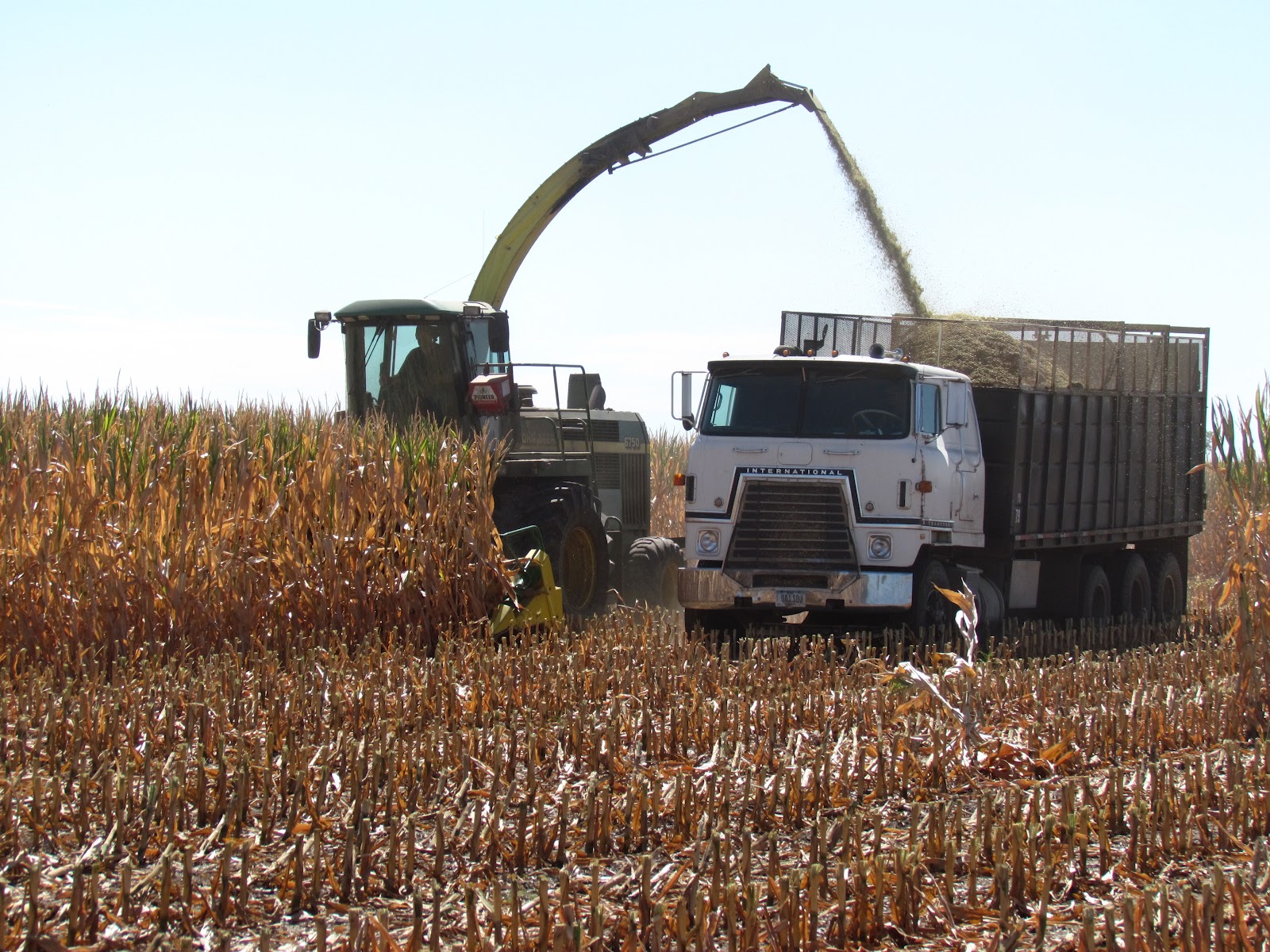
In a normal year, the corn would not start to dry until sometime in September-November.  Then when corn is dry to about only 18 percent moisture it would be harvested with combines and the corn kernals would be harvested as grain.  But since it has been such an extreme drought this year, some of the corn plants didn't even produce any ears of corn.  So basically, it is just a stalk. So instead of wasting the crop completely, we chop the corn plant and all into silage.  Which is fed to cattle.
The corn is chopped up and loaded into trucks. 
 The silage is then dumped into piles.
Pappa Lyle directing traffic.  I think he likes giving orders :) (dont tell him i said that. haha)
Once the corn is dumped, we use tractors to pack the silage tight into bunkers where it is then  covered to protect it from the elements and keep it fresh to eat for the cattle.
I like to look at this process and say... When Life Hands You Lemons, Make Lemonade, or Chop Corn Silage, whatever suits your fancy. 

...that's what she said
Ashley

Thursday, July 26, 2012

Tale of Two Corns


First off, let me apologize to my avid blog followers for missing like a week of blogs and COUNTRY MUSIC MONDAY! Somebody kick me please.  So for all you followers,well I guess just Molly, I am sorry that I couldn’t waste five minutes of your past few days with my random ramblings and thoughts.

So in my opinion, the best month of the year = July, handsdown! And I have several reasons why,

1.    The most obvious of all, my birthday! Wha what!
2.    Lighting tiny explosives
3.    Amazing selection of summer sandals are in everystore!
4.    The grill gets fired up at every possible meal!
5.    County Fair time baby!
6.    And… SWEET CORN!!!

This past weekend, I was back at home on the farm and it wasSWEET CORN TIME! Now no matter where you come from, what your background,everybody and their dog loves some good sweet corn. 

Peyton loves some fresh picked sweet corn!
At my house for some reason we seem to think that there isgoing to be a shortage of sweet corn so we plant 10 times what the normalperson plants.  But hey, its allgood, because then we get to give away some great produce to friends and familyto enjoy.

So I lucked out this year because by the time I came home for the weekend, a good chunk of the sweet corn crop had been picked, so myonly task was to husk a few tub fulls for my own personal pleasure. 


Now I would like to debunk a myth about corn to many who maybe confused.  When you drive up anddown a country back road and you see all those rows of corn, that is fieldcorn, NOT sweet corn.  You have noidea how many times I have been asked by people if I ever get tired of eatingcorn since my family grows several thousand acres of it.  Just as an fyi, if you tried to gnaw ona ear of field corn, you would probably chip a tooth.

There are two corns in the US, and field corn is by far themost common, grown on more than 99% of all corn acres.  While a small portion is process foruses as corn cereal, cornstarch, corn oil, corn syrup for human consumption, itis primarily used for livestock feed, ethanol production, and othermanufactured goods. 

There are tens of millions of acres planted to field cornwhile only 600,000 acres are planted to corn.

34% of field corn supply in the U.S. is used as feed forlivestock such as beef, pork, and poultry.

37% is used for ethanol production. 
12% is exported to other countries

So all in all, when you go to the grocery store and bagthose bright green husked ears of sweet corn, don’t think that it came fromthose miles and miles of corn you see when your driving down the road.   There is a tale of two corns inNebraska.

...that's what she said
Ashley

Monday, June 25, 2012

I'm a "Corn Star"


So, for this weeks County Music Monday, I'm gonna ditch the life lessons and philosophical-ness which I usually try and convey to you all, and replace it with some, well I'm not quite sure yet.  I guess I'm winging this post tonight. haha

So this weeks song is CORN STAR by the one and only Craig Morgan.  I stumbled upon this song about two weeks ago and immediately fell in LOVE with it.  I honestly am a true sucker for funny songs with great innuendos. So thus I present you with.... CORN STAR.

So instead of me relating this song to life, I'm just gonna give you some great CORN facts.  Since my family makes a majority of its living fromcorn production, it only seems fit.
So here we go....  
  1. U.S. farmers produce about 40 percent of the world's corn, using only 20 percent of the total area harvested in the world. 
  2. One bushel of corn is 56 pounds. That means U.S. farmers produce an average of more than 9,000 pounds of corn per acre. 
  3. If U.S. farmers used crop production practices from 1931 to produce an amount of corn equivalent to the 2008 crop, it would require 490 million acres—an area more than 120 million acres larger than the state of Alaska.
  4. Individuals or families own 82 percent of corn farms. Another 6 percent are family-held corporations.
  5. Less than 15 percent of U.S. corn acres are irrigated.
  6. Farmers today produce 70 percent more corn per pound of fertilizer than as recently as the 1970s.
  7. Corn farmers have reduced total fertilizer use by 10 percent since 1980.
  8. According to the USDA, one acre of corn… removes about 8 tons of carbon dioxide from the air in a growing season…at 180 bushels per acre produces enough oxygen to supply a year’s needs for 131 people.
  9. Corn production has marched steadily upward for decades while using fewer acres.
  10. American farmers produced the five largest corn crops in history during the past five years. Even after supplying food-makers, ranchers, ethanol producers and grain exporters, America will again be able to save 10 percent of this year’s harvest for the future.
  11. Farmers today grow five times as much corn as they did in the 1930s — on 20 percent less land. That is still 13 million acres, or 20,000 square miles, twice the size of Massachusetts.
  12. The yield per acre has skyrocketed from 24 bushels in 1931 to 154 now, or a six-fold gain.
Now it is sad to say that many people in our world today are uneducated in the facts about farming and ranching in America.  It is not always their fault though, many people have never been exposed to truths about the agriculture industry, because today the average consumer is 3 generations removed from the farm. Because of this fact, most consumers get their thoughts and opinions from public figures, social media, and television, none of which most of the time are connected to production agriculture and report the facts.
 

So again I say, like I always do, it doesn't matter what your choices and opinions are when it comes to your food choices, but it does matter that you are making choices that are based on truth and facts from the people who produce your food.  The ones who work extremely hard to produce the safest and healthiest food for us as consumers to enjoy.

You as a consumer are not the only ones who eat the food that farmers and ranchers produce, they eat it as well.  So don't you think they would want to raise safe and healthy food? Farmers and Ranchers eat from the same table as the rest of us. 


...that's what she said 
Ashley